
GENERAL GUIDELINES
Types of Manuscripts: The Indonesian Journal of Nutrition and Dietetics (JGDI) accepts original research articles and review articles in the fields of nutrition and dietetics, including clinical nutrition, maternal and child nutrition, public health nutrition, obesity and nutrition-related non-communicable diseases, food service management, and food science and technology. Submitted manuscripts are evaluated based on their novelty, methodological rigor, and adherence to ethical standards. For further information, please refer to the journal’s publication ethics and author guidelines.
Language: Manuscripts must be written in English using accurate grammar, standard academic language, and clear, concise, and unambiguous expressions.
Originality and Research Ethics: Submitted manuscripts must not have been previously published in any journal or other publication and must not be under consideration for publication elsewhere. Authors conducting research involving human participants must provide evidence of ethical approval (ethical clearance). Authors must also submit a similarity report generated using Turnitin.
Document Format: Manuscripts must be prepared using Microsoft Word (.doc or .docx) on A4-sized paper, with standard margins of 2.54 cm (1 inch) on all sides, single line spacing, and formatting consistent with the journal’s manuscript template.
Manuscripts should consist of the following sections: title, author name(s), author address(es), author institution(s), abstract, introduction, materials and methods, results and discussion, conclusion and recommendations, acknowledgements (if necessary), and references. Detailed provisions can be found in the writing guidelines.
Each manuscript is blindly reviewed by at least two peer reviewers. Decisions for publication, revision, or rejection are based on reviewers’ recommendations. Manuscripts that are not accepted for publication will not be returned to the authors unless requested. Revised manuscripts should be returned to the editor without delay. Authors are fully responsible for the content of their articles.
All manuscripts must be submitted online through the IJND Editorial Office at:
http://ejournal.almaata.ac.id/index.php/IJND
Manuscript Template
All manuscripts must be prepared using the IJND Microsoft Word article template:
Template: Template Manuscript IJND
Guidelines for Online Submission
Authors must first register as an Author at:
http://ejournal.almaata.ac.id/index.php/IJND/user/register
After completing the registration form, click the Register button.
To begin the submission process, click New Submission and follow these steps:
Step 1 – Starting the Submission
Authors must read and check the submission checklist and copyright notice. Comments for the editor may be added.
Step 2 – Uploading the Submission
Click Browse (or Choose File) to locate the manuscript file on your computer, then click Open. Click Upload, and once completed, click Save and Continue.
Step 3 – Entering Submission Metadata
Enter author metadata, including the corresponding author. Insert the manuscript title, abstract, and keywords into the provided text fields.
Step 4 – Uploading Supplementary Files
Authors are required to upload an author statement letter. Supplementary files may include research instruments, datasets (in accordance with research ethics), unavailable sources, figures, tables, or other supporting materials.
Step 5 – Confirmation
Click Finish Submission to complete the process. The corresponding author will receive a confirmation email and may track the manuscript’s progress by logging into the journal website.
Authors can monitor manuscript status at any time through the online submission system.
Author Fee
This journal charges the following fees:
Article Submission Fee: IDR 0.00
Authors are required to pay an Article Submission Fee as part of the submission process to contribute to review costs.
Article Publication Fee: IDR 1,000,000.00
If the manuscript is accepted, authors will be asked to pay an Article Publication Fee to cover publication costs.
Guidelines of Writing
Manuscripts should be typed using Microsoft Word on A4 paper, Arial font size 11, 1.5 spacing, with margins of 3 cm on all sides. Manuscript length should be 8–15 pages, with page numbers placed at the bottom right corner.
1. Title
The title should be written in English, be specific and concise, and not exceed 12 words in Bahasa Indonesia or 10 words in English (or 90 characters).
The title should be capitalized at the beginning of the sentence.
2. Author Name and Institution
Author names should be written without academic degrees, followed by superscript letters corresponding to institutional affiliations and addresses.
One author must be designated as the corresponding author, including an email address or phone number.
3. Abstract and Keywords
The abstract should provide a concise overview of the manuscript’s main content. It must be written in English as a single paragraph of no more than 250 words, using Arial, 11-point font, and single line spacing. The abstract should include the following elements:
Background: Describe the main research problem and the rationale for conducting the study.
Objectives: State the specific objectives of the study.
Methods: Briefly describe the study design, setting or population, sample size, measurement instruments, and statistical analyses.
Results: Present the principal findings, including relevant statistical data such as percentages and p-values.
Conclusions: Provide a conclusion that directly addresses the study objectives and is supported by the findings.
Keywords: Provide 3–5 keywords or phrases, arranged alphabetically and separated by semicolons (;).
Article Information
This section is completed by the Editorial Office and includes the following dates: Received, 1st Revision, 2nd Revision, Accepted, Available Online, and Published.
4. Introduction
The Introduction should provide a concise background to the nutrition or health problem being investigated, including the magnitude of the problem (prevalence or disease burden), the research gap, and the scientific rationale for conducting the study. The section should conclude with a clear statement of the study objectives. Citations: Use the Vancouver referencing style, with references indicated by Arabic numerals in parentheses, such as (1), (2,3), or (14–16). The Introduction should present the relevant literature and scientific background, culminating in the objectives of the study. The paragraphs should systematically establish the research context, explain why the research problem arises, and identify the research gap that warrants further investigation. Authors may demonstrate the novelty of their research by critically examining and comparing previous studies. The research question may be explicitly stated in this section, and the central argument of the study should be clearly articulated (1). The Introduction should concisely describe the research background, novelty, current state of knowledge, and study objectives. The discussion should be logically structured, efficiently written, and supported by relevant references. Subheadings, numbering, and bullet points should not be used in this section (1).
5. Materials and Methods
This section should briefly describe the study design, research period, study population and sample, and research variables. For experimental studies involving laboratory procedures, the principal materials and ingredients must be described in sufficient detail, including their specifications and sources. The methods should be described clearly enough to allow the study to be replicated. Methods adopted from previously published sources must be appropriately cited.
The statistical methods used for data analysis should be described concisely. For studies involving human participants, authors must state the ethical approval number and identify the institution or ethics committee that granted the approval (2).
6. Results and Discussion
The results should be presented clearly and systematically using tables and figures, where appropriate. All tables and figures must be cited in the text and accompanied by sufficiently informative titles and captions so that they can be understood independently of the main text.
Table titles should be placed above the tables, whereas figure captions should be placed below the figures. Tables and figures must be numbered consecutively in the order in which they are first mentioned in the manuscript.
To facilitate the editorial and production processes, authors should provide editable or high-quality electronic versions of tables and figures. Tables should preferably be submitted in Excel format, while figures should be provided in an appropriate image format, such as JPEG or TIFF.
Tables should be numbered using Arabic numerals and accompanied by concise captions that clearly describe their content. A maximum of five tables and figures combined is permitted per manuscript. Every table and figure must be explicitly cited in the text. If previously published data are reproduced, authors must obtain the necessary permission and acknowledge the original source appropriately.
Example of table formatting:
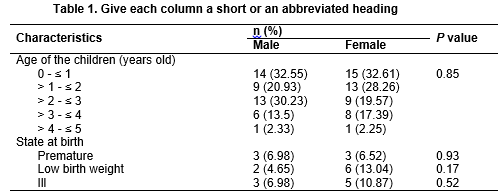
Note: The numerical values are reproduced from the original guidelines and should be verified against the source data before publication.
The Results section should explain the findings of the data analysis rather than merely repeat the information presented in tables and figures. The results should include relevant tables, figures, and explanations of the analytical findings in relation to the study objectives.
Tables and figures must have clear titles and descriptions. Table titles should appear above the tables, while figure captions should be placed below the figures. They must be numbered consecutively according to the order in which they appear in the text. Table titles and figure captions should use title case, with the principal words capitalized. The main section heading should be written in uppercase and bold, while subsection headings should use title case and bold formatting.
Figures must be professionally prepared or photographed and submitted in JPEG or TIFF format at a resolution of at least 300 dots per inch (dpi) for grayscale or color images in RGB (red, green, blue) mode.
For X-ray images, scans, other diagnostic images, pathology specimens, and photomicrographs, authors should provide sharp, high-quality photographic images in grayscale or color, as appropriate. The recommended image size is approximately 127 × 173 mm (5 × 7 inches).
Tables and figures must be numbered consecutively according to the order in which they are cited in the text. If a table or figure has been published previously, authors must acknowledge the original source and obtain written permission from the copyright holder for reproduction. Permission is required regardless of the authorship or publisher, except for material in the public domain or material used under an applicable license, such as CC BY-SA.
Color figures may be accepted under special circumstances, provided that the authors agree to cover any associated reproduction costs. If the original figures are too large for submission, authors may initially submit lower-resolution versions, provided that high-resolution files are available upon manuscript acceptance.
7. Conclusion and Recommendation
Conclusion: Summarize the principal findings concisely and directly in relation to the study objectives. Recommendations: Provide practical recommendations, where applicable, for the general public or patients, healthcare institutions, and future research.
8. Acknowledgements
The Acknowledgments section should identify individuals or institutions that contributed to the research or manuscript but do not qualify for authorship.
Relevant research programs, grants, scholarships, and contracts should be acknowledged, including the names of funding agencies and grant or contract numbers, where applicable. Authors should also acknowledge individuals or organizations that assisted with the research, including those who provided access to information, facilitated surveys, or assisted with interviews and other research activities.
patients, healthcare institutions, and future research.
9. Author Contributions
The Acknowledgments section should identify individuals or institutions that contributed to the research or manuscript but do not qualify for authorship.
Relevant research programs, grants, scholarships, and contracts should be acknowledged, including the names of funding agencies and grant or contract numbers, where applicable. Authors should also acknowledge individuals or organizations that assisted with the research, including those who provided access to information, facilitated surveys, or assisted with interviews and other research activities.
Access to information, facilitated surveys, or assisted with interviews and other research activities.
10. Declaration of Generative AI and AI-Assisted Technologies
If applicable, authors should disclose the use of generative artificial intelligence (AI) tools or AI-assisted technologies in preparing the manuscript. If no such tools or technologies were used, the following statement may be provided: “The authors declare that no generative AI tools or AI-assisted technologies were used in the preparation of this manuscript.”
11. Author Contributions Statement
Authors must specify the individual contributions of all co-authors using their initials and clearly describe their respective roles.
Example:
IA contributed to data collection and manuscript preparation. VA was responsible for conceptualization and methodology, supervised data collection, and contributed to drafting and revising the manuscript. ASA reviewed the original draft. NK, RF, and DE contributed to conceptualization and methodology. EA contributed to product formulation.
12. Conflict of Interest and Funding Disclosure
All authors must disclose any potential conflicts of interest related to the research or publication. If no conflicts of interest exist, the following statement may be used:
“The authors declare that they have no conflicts of interest related to this article.”
Authors must also disclose the source of funding for the research, including the name of the funding agency or sponsor and the grant or contract number, where applicable.
Example:
“This research was funded by [name of funding agency or sponsor] under grant/contract number [grant or contract number].”
If the research received no external funding, authors should provide an appropriate declaration.
13. References
- The manuscript must contain at least 20 references. At least 80% of the references should be recent journal articles published within the past 10 years, while up to 20% may consist of older books or other relevant sources.
- References must follow the Vancouver referencing style. The use of reference management software, such as Mendeley, is recommended.
- References must be numbered consecutively according to their first appearance in the text. Reference numbers should be written using Arabic numerals in parentheses.
Examples:
“The accuracy of the data in this study was assessed by comparison with the 2010 Basic Health Research (Riskesdas) findings (1).”
“Studies conducted in the United States have also reported similar findings (2).”
- Journal titles may be abbreviated according to the Index Medicus guidelines. A list of standard journal title abbreviations is available through the National Library of Medicine website: https://www.nlm.nih.gov.
- References must not be cited in the abstract.
- Articles accepted for publication but not yet published should be cited as “in press” or “forthcoming.” Manuscripts submitted to a journal but not yet accepted should generally not be cited as established publications. If such information is essential, it may be described as an unpublished observation, subject to the author's written permission.
- Personal communications and unpublished observations should be avoided as references unless essential to the manuscript. Written permission must be obtained from the individuals concerned, where applicable.
- Authors are responsible for verifying the accuracy and completeness of all references against the original source documents.
Note: Manuscripts must be at least 8 pages and no more than 15 pages in length.