
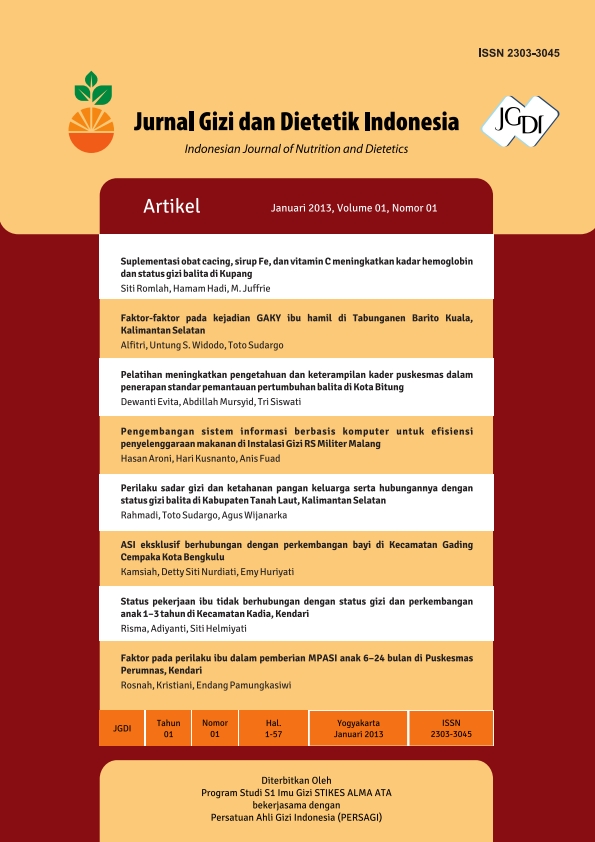
Status pekerjaan ibu tidak berhubungan dengan status gizi dan perkembangan anak 1–3 tahun di Kecamatan Kadia, Kendari
Article Sidebar
Submitted
9 March 2016
Accepted
9 March 2016
Published
9 March 2016
Abstract
ABSTRACT
Background: The ï¬ rst three years is a golden period or critical period for optimum growth and development process. Mothers at work will affect their role in taking care of their children resulting in limited time to feed the children. In 2004 it was estimated that 23% of children had development disorder; abnormal growth of infants occured 80% in mothers at work. In 2007 in Indonesia the prevalence of malnourished underï¬ ves was 8.8% and malnourished was 19.2%. At the Province of Sulawesi Tenggara the prevalence of under nutrition is 2.7% and undernourishment is 13.6%. At Kendari Municipality the prevalence of malnutrition is 0.9% and undernourishment is 3.2%.
Objective: To identify the association between occupational status of mothers and nutrition status and development of children of 1 – 3 years at Subdistrict of Kendari Municipality.
Method: This observational research used a cross sectional design and was carried out at Subdistrict of Kendari Municipality. Population were all children of 1–3 years. Subjects consisted of 150 children taken with systematic random sampling technique. Research instruments were questionnaire, recall list, Denver II Scale and length measurement. Data analysis used chi square statistical test and logistic regression with conï¬ dence interval (CI) 95%.
Result: There were no signiï¬ cant association between occupation of mothers (p=0.106; OR=1.84), education of mothers (p=0.518; OR=1.31), income percapita (p=0.934; OR=0.91) and nutritional status of children. There was signiï¬ cant association between feeding pattern (p=0.008; OR=2.58), duration of rearing (p=0.024; OR=2.28) and nutritional status of children. There was no signiï¬ cant association between occupation of mothers (p=0.275; OR=1.57), education of mothers (p=0.674; OR=1.23) income percapita (p=0.516; OR=0.74) and child development. There was signiï¬ cant association between duration of rearing and child development (p=0.029; OR=2.30). There was signiï¬ cant association between occupation of mothers and feeding pattern of children (p=0.32; OR=2.30). Factor of feeding pattern had the greatest contribution (3%) to undernourished nutrition status; and duration of rearing contributed as much as 3% to delayed child development.
Conclusion: There was no association between occupational status of mothers and nutrition status and development of children of 1-3 years. There was association between occupational status of mothers and feeding pattern of children of 1 – 3 years. There was association between feeding pattern and nutrition status of children of 1- 3 years at Subdistrict of Kadia, Kendari Municipality.
KEYWORDS: occupational status of mothers, nutritional status, child development
ABSTRAK
Latar belakang: Tiga tahun pertama merupakan periode keemasan (golden period)ataumasakritis (critical period) untuk optimalisasi proses tumbuh kembang. Ibu yang bekerja akan menghambat peran ibu dalam merawat dan mengasuh anak sehingga anak tidak mendapat waktu cukup untuk urusan makan. Pada tahun 2004 diperkirakan sekitar 23% anak mengalami gangguan perkembangan dan 80% perkembangan bayi tidak normal pada ibu yang bekerja. Pada tahun 2007, di Indonesia prevalensi balita gizi buruk 8,8% dan gizi kurang 19,2 %. Untuk daerah Provinsi Sulawesi Tenggara, gizi buruk dan kurang masing-masing sebesar 2,7% dan 13,6%, sedangkan di Kota Kendari 0,9% dan 3,2%.
Tujuan: Mengetahui hubungan status pekerjaan ibu dengan status gizi dan perkembangan anak usia 1–3 tahun di Kecamatan Kadia, Kota Kendari.
Metode: Penelitian ini merupakan penelitian observasional dengan rancangan cross sectional. Wilayah penelitian di Kecamatan Kadia, Kota Kendari. Populasi adalah seluruh anak balita dengan usia 1–3 tahun di Kecamatan Kadia Kota Kendari. Sampel dalam penelitian sebanyak 156 subjek. Pengambilan sampel dengan systematic random sampling. Instrumen yang digunakan dalam penelitian adalah kuesioner, daftar recall, Denver II Dacin dan panjang badan. Analisis data dengan uji Chi-Square dan regresi logistik dengan conï¬ dence interval (CI) 95%.
Hasil: Tidak terdapat hubungan signiï¬ kan antara pekerjaan ibu (p=0,106; OR=1,84), pendidikan ibu (p=0,518; OR=1,31), pendapatan per kapita (p=0,934; OR=0,91) dengan status gizi anak. Terdapat hubungan yang signiï¬ kan antara pola asuh makan (p= 0,008; OR=2,58), waktu pengasuhan (p=0,024; OR=2,28) dengan status gizi anak. Tidak terdapat hubungan yang signiï¬kan antara pekerjaan ibu (p=0,275; OR=1,57), pendidikan ibu (p=0,674; OR=1,23), pendapatan per kapita (p=0,516;
OR=0,74) dengan perkembangan anak. Terdapat hubungan signiï¬ kan antara waktu pengasuhan dengan perkembangan anak (p=0,029; OR=2,30). Terdapat hubungan signiï¬ kan antara pekerjaan ibu dengan pola asuh makan anak (p=0,030; OR=2,30). Faktor yang kontribusinya paling besar terhadap status gizi kurang adalah pola asuh makan yaitu sebesar 3%, sedangkan terhadap keterlambatan perkembangan anak adalah waktu pengasuhan yaitu sebesar 3%.
Kesimpulan: Status pekerjaan ibu tidak berhubungan dengan status gizi dan perkembangan anak usia 1-3 tahun, Status pekerjaan ibu berhubungan dengan pola asuh makan anak usia 1-3 tahun, Pola asuh makan berhubungan dengan status gizi anak usia 1-3 tahun di Kecamatan Kadia, Kota Kendari.
KATA KUNCI: pekerjaan ibu, perkembangan anak, status gizi anak
Background: The ï¬ rst three years is a golden period or critical period for optimum growth and development process. Mothers at work will affect their role in taking care of their children resulting in limited time to feed the children. In 2004 it was estimated that 23% of children had development disorder; abnormal growth of infants occured 80% in mothers at work. In 2007 in Indonesia the prevalence of malnourished underï¬ ves was 8.8% and malnourished was 19.2%. At the Province of Sulawesi Tenggara the prevalence of under nutrition is 2.7% and undernourishment is 13.6%. At Kendari Municipality the prevalence of malnutrition is 0.9% and undernourishment is 3.2%.
Objective: To identify the association between occupational status of mothers and nutrition status and development of children of 1 – 3 years at Subdistrict of Kendari Municipality.
Method: This observational research used a cross sectional design and was carried out at Subdistrict of Kendari Municipality. Population were all children of 1–3 years. Subjects consisted of 150 children taken with systematic random sampling technique. Research instruments were questionnaire, recall list, Denver II Scale and length measurement. Data analysis used chi square statistical test and logistic regression with conï¬ dence interval (CI) 95%.
Result: There were no signiï¬ cant association between occupation of mothers (p=0.106; OR=1.84), education of mothers (p=0.518; OR=1.31), income percapita (p=0.934; OR=0.91) and nutritional status of children. There was signiï¬ cant association between feeding pattern (p=0.008; OR=2.58), duration of rearing (p=0.024; OR=2.28) and nutritional status of children. There was no signiï¬ cant association between occupation of mothers (p=0.275; OR=1.57), education of mothers (p=0.674; OR=1.23) income percapita (p=0.516; OR=0.74) and child development. There was signiï¬ cant association between duration of rearing and child development (p=0.029; OR=2.30). There was signiï¬ cant association between occupation of mothers and feeding pattern of children (p=0.32; OR=2.30). Factor of feeding pattern had the greatest contribution (3%) to undernourished nutrition status; and duration of rearing contributed as much as 3% to delayed child development.
Conclusion: There was no association between occupational status of mothers and nutrition status and development of children of 1-3 years. There was association between occupational status of mothers and feeding pattern of children of 1 – 3 years. There was association between feeding pattern and nutrition status of children of 1- 3 years at Subdistrict of Kadia, Kendari Municipality.
KEYWORDS: occupational status of mothers, nutritional status, child development
ABSTRAK
Latar belakang: Tiga tahun pertama merupakan periode keemasan (golden period)ataumasakritis (critical period) untuk optimalisasi proses tumbuh kembang. Ibu yang bekerja akan menghambat peran ibu dalam merawat dan mengasuh anak sehingga anak tidak mendapat waktu cukup untuk urusan makan. Pada tahun 2004 diperkirakan sekitar 23% anak mengalami gangguan perkembangan dan 80% perkembangan bayi tidak normal pada ibu yang bekerja. Pada tahun 2007, di Indonesia prevalensi balita gizi buruk 8,8% dan gizi kurang 19,2 %. Untuk daerah Provinsi Sulawesi Tenggara, gizi buruk dan kurang masing-masing sebesar 2,7% dan 13,6%, sedangkan di Kota Kendari 0,9% dan 3,2%.
Tujuan: Mengetahui hubungan status pekerjaan ibu dengan status gizi dan perkembangan anak usia 1–3 tahun di Kecamatan Kadia, Kota Kendari.
Metode: Penelitian ini merupakan penelitian observasional dengan rancangan cross sectional. Wilayah penelitian di Kecamatan Kadia, Kota Kendari. Populasi adalah seluruh anak balita dengan usia 1–3 tahun di Kecamatan Kadia Kota Kendari. Sampel dalam penelitian sebanyak 156 subjek. Pengambilan sampel dengan systematic random sampling. Instrumen yang digunakan dalam penelitian adalah kuesioner, daftar recall, Denver II Dacin dan panjang badan. Analisis data dengan uji Chi-Square dan regresi logistik dengan conï¬ dence interval (CI) 95%.
Hasil: Tidak terdapat hubungan signiï¬ kan antara pekerjaan ibu (p=0,106; OR=1,84), pendidikan ibu (p=0,518; OR=1,31), pendapatan per kapita (p=0,934; OR=0,91) dengan status gizi anak. Terdapat hubungan yang signiï¬ kan antara pola asuh makan (p= 0,008; OR=2,58), waktu pengasuhan (p=0,024; OR=2,28) dengan status gizi anak. Tidak terdapat hubungan yang signiï¬kan antara pekerjaan ibu (p=0,275; OR=1,57), pendidikan ibu (p=0,674; OR=1,23), pendapatan per kapita (p=0,516;
OR=0,74) dengan perkembangan anak. Terdapat hubungan signiï¬ kan antara waktu pengasuhan dengan perkembangan anak (p=0,029; OR=2,30). Terdapat hubungan signiï¬ kan antara pekerjaan ibu dengan pola asuh makan anak (p=0,030; OR=2,30). Faktor yang kontribusinya paling besar terhadap status gizi kurang adalah pola asuh makan yaitu sebesar 3%, sedangkan terhadap keterlambatan perkembangan anak adalah waktu pengasuhan yaitu sebesar 3%.
Kesimpulan: Status pekerjaan ibu tidak berhubungan dengan status gizi dan perkembangan anak usia 1-3 tahun, Status pekerjaan ibu berhubungan dengan pola asuh makan anak usia 1-3 tahun, Pola asuh makan berhubungan dengan status gizi anak usia 1-3 tahun di Kecamatan Kadia, Kota Kendari.
KATA KUNCI: pekerjaan ibu, perkembangan anak, status gizi anak
Authors
Copyright and license info is not available