
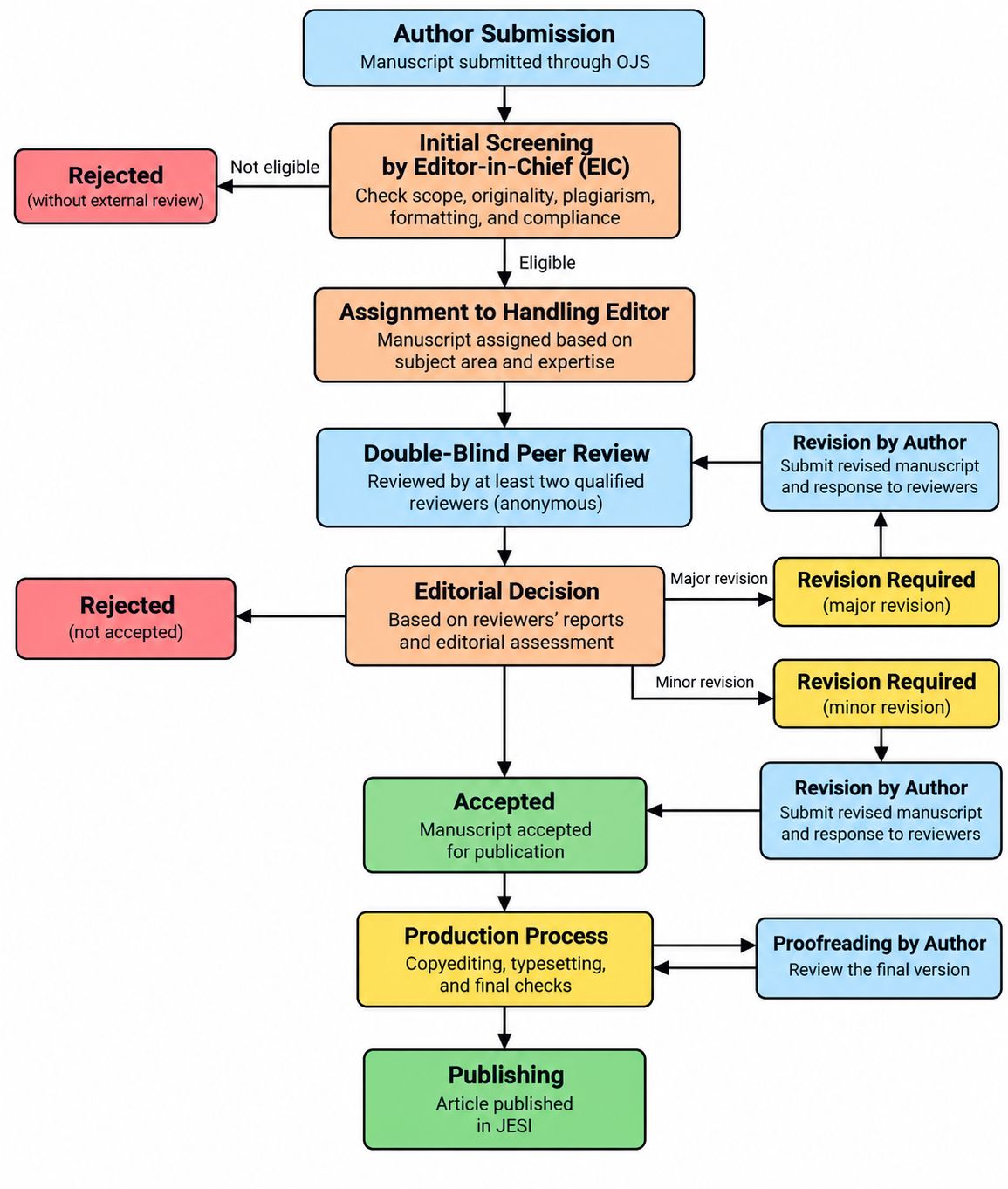
Jurnal Ekonomi Syariah Indonesia (JESI) is committed to maintaining academic integrity, scholarly quality, and transparency in its publication process. Each submitted article undergoes evaluation by two reviewers and a rigorous double-blind peer review process, in which the identities of authors and reviewers remain confidential throughout the evaluation. The journal ensures that editorial decisions are based on scientific merit, originality, methodological rigor, relevance, and contribution to the advancement of Islamic economics and related disciplines.
1. Initial Screening (Desk Evaluation)
All submitted manuscripts undergo an initial evaluation by the Editor-in-Chief and the Editorial Board to determine their suitability for publication. This evaluation considers the manuscript's relevance to the journal's aims and scope, originality, academic contribution, methodological quality, compliance with author guidelines, and similarity screening results.
Manuscripts that fail to meet the journal's minimum academic and editorial standards may be rejected at this stage without proceeding to external peer review.
2. Assignment of Handling Editor
Manuscripts that successfully pass the initial screening are assigned to a Handling Editor based on the manuscript's subject area and academic relevance. The Handling Editor coordinates the peer review process, selects appropriate reviewers, monitors the evaluation, and provides editorial recommendations.
3. Double-Blind Peer Review
Each manuscript is evaluated by at least two independent reviewers with relevant academic expertise. JESI applies a double-blind peer review policy to ensure impartiality and minimize potential bias during the evaluation process.
Reviewers assess manuscripts based on originality, theoretical contribution, research objectives, methodological appropriateness, analytical rigor, validity of findings, quality of discussion, and relevance to Islamic economics.
Reviewers are also expected to maintain confidentiality, disclose potential conflicts of interest, and provide objective, constructive, and academically justified recommendations.
4. Editorial Decision
Following the peer review process, the Handling Editor evaluates the reviewers' recommendations and submits an editorial recommendation. The editorial decision may fall into one of the following categories:
1. Accept Submission: The manuscript meets the journal's publication standards and requires no substantive revisions.
2. Revision Required: The manuscript requires minor or moderate improvements before further editorial consideration.
3. Resubmit for Review: The manuscript requires substantial revisions and may undergo an additional round of peer review.
4. Decline Submission: The manuscript does not meet the journal's academic standards or publication requirements.
Editorial decisions and anonymized reviewer comments are communicated to the corresponding author through the journal's Open Journal Systems (OJS) platform.
5. Revision and Resubmission
Authors receiving revision requests must revise their manuscripts according to the reviewers' and editors' recommendations. Revised manuscripts must be submitted through the OJS platform, accompanied by a point-by-point response explaining how each comment has been addressed.
Authors are expected to provide clear academic justification for any reviewer recommendations that are not incorporated into the revised manuscript.
6. Final Evaluation and Acceptance
The Handling Editor evaluates revised manuscripts to determine whether the reviewers' concerns have been adequately addressed. When necessary, revised manuscripts may be returned to the original reviewers for further assessment.
The Editor-in-Chief makes the final publication decision based on the review reports, editorial recommendations, and the manuscript's overall academic quality. Manuscripts that successfully complete the evaluation process receive an official acceptance notification through the journal's editorial system.
7. Editorial Oversight and Ethical Considerations
The Editor-in-Chief retains final responsibility for maintaining the integrity, fairness, and consistency of the peer review process. Editorial decisions must be based exclusively on academic merit and must remain independent of authors' institutional affiliations, nationality, or other non-academic considerations.
JESI is committed to preventing conflicts of interest, maintaining reviewer confidentiality, addressing research misconduct, and ensuring ethical standards throughout the editorial and publication process.
Any disputes, appeals, or concerns regarding editorial decisions will be evaluated by the Editor-in-Chief in accordance with the journal's editorial policies and publication ethics.