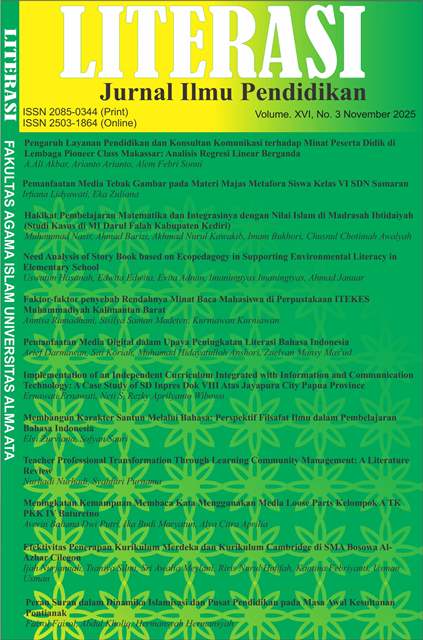
Upaya Peningkatan Kemampuan Pemecahan Masalah Matematis Siswa Kelas Vii Smp Muhammadiyah 9 Yogyakarta Melalui Penerapan Pendekatan Pembelajaran Problem Posing
DOI:
https://doi.org/10.21927/literasi.2013.4(1).53-70Abstract
Problem-solving ability is one of the objectives to be achieved in mathematics. This capability is not only used in solving problems related to the field of mathematics, but can be used in solving the problems faced by students in the day-to-day life. One way to develop this ability in mathematics learning is learning by problem posing approach. This approach gives the opportunity for students to formulate questions that are simpler than the available problems. This research aims is to improve the ability of mathematical problem solving of students of grade VIIA, Junior High School of Muhammadiyah 9 Yogyakarta through learning “problem solvingâ€. This is a classroom action research; with the subject of the research were seventh grade students of Junior High School of Muhammadiyah 9 Yogyakarta. The results of study showed that the approach can enhance the ability of posing a problem-solving mathematical, grade VII A Junior High School of Muhammadiyah 9 Yogyakarta.
Keywords : Problem posing, problem solving ability
Downloads
Published
Issue
Section
License
Authors who publish with this journal agree to the following terms:
1. Authors retain copyright and grant the journal right of first publication, with the work [SPECIFY PERIOD OF TIME] after publication simultaneously licensed under a Creative Commons Attribution License that allows others to share the work with an acknowledgement of the work's authorship and initial publication in this journal.
Â
2. Authors are able to enter into separate, additional contractual arrangements for the non-exclusive distribution of the journal's published version of the work (e.g., post it to an institutional repository or publish it in a book), with an acknowledgement of its initial publication in this journal.
Â
3. Authors are permitted and encouraged to post their work online (e.g., in institutional repositories or on their website) prior to and during the submission process, as it can lead to productive exchanges, as well as earlier and greater citation of published work (See The Effect of Open Access).
Â

LITERASI by http://ejournal.almaata.ac.id/index.php/LITERASI is licensed under a Creative Commons Attribution-ShareAlike 4.0 International License.