
The INPHARNMED Journal employs a strict double-blind peer-review process to ensure the highest standards of scientific integrity and publication quality. Peer reviewers play a vital role in maintaining the journal's Scopus and DOAJ indexation standards by providing objective, constructive, and timely feedback (Figure 1).
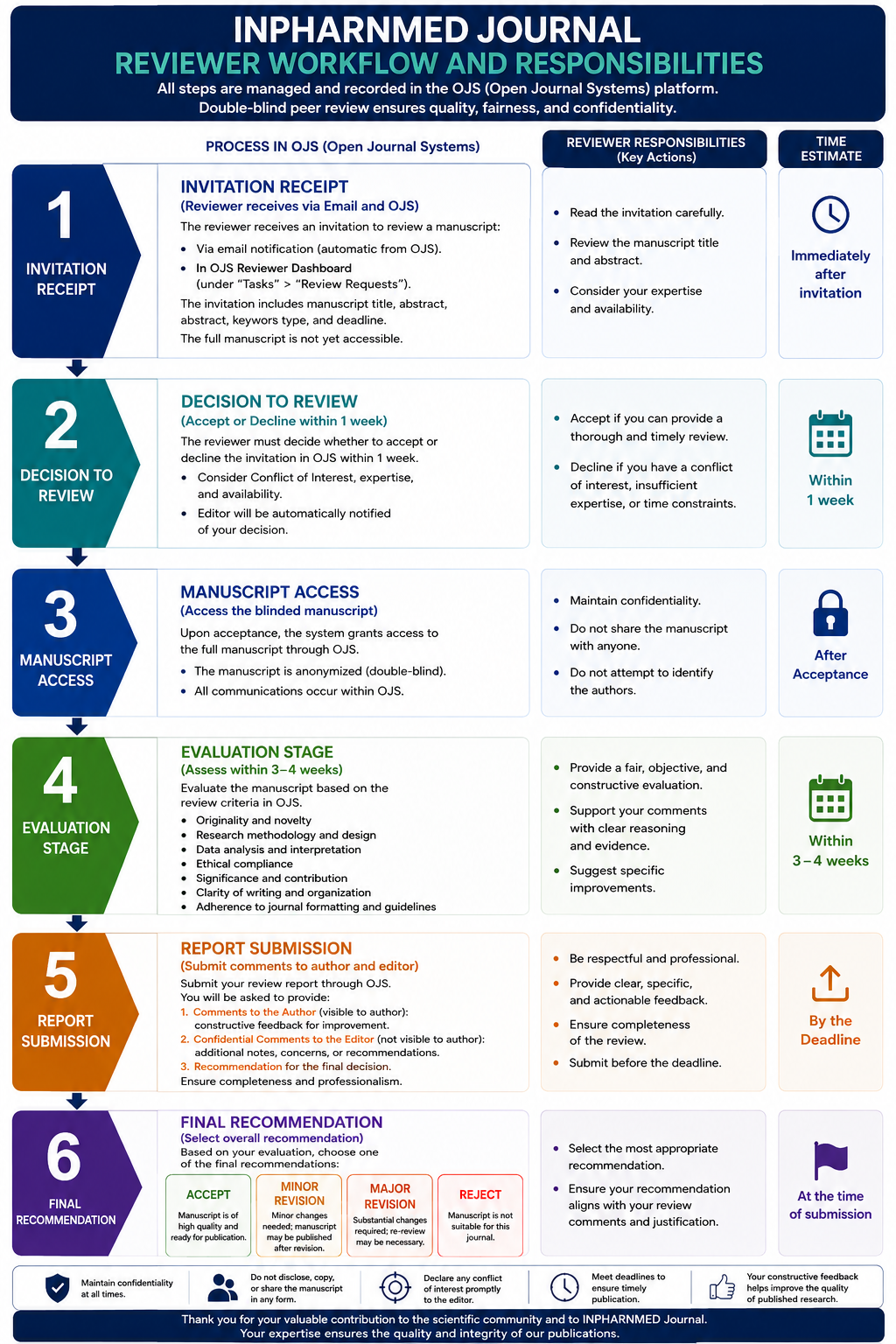
Figure 1. Reviewer Workflow
- REVIEWER BOUNDARIES AND CONFIDENTIALITY
- Double-Blind Policy: The identities of both the authors and the reviewers are strictly concealed. Reviewers must not attempt to discover the identity of the authors or contact them directly under any circumstances. All communications must be directed through the Managing Editor via the Open Journal Systems (OJS).
- Confidentiality: The manuscript is a confidential document. Reviewers are strictly prohibited from sharing, discussing, or using any unpublished data, concepts, or materials from the manuscript for their own research or personal gain.
- Conflict of Interest (COI): Before accepting an invitation, reviewers must evaluate potential conflicts of interest. If a reviewer suspects they know the author or has any financial, personal, or professional affiliations that could bias their judgment, they must immediately decline the review invitation and notify the Editorial Board.
- TIME COMMITMENT AND DEADLINES
- Invitation Response: Reviewers are expected to accept or decline the review invitation within one (1) week of receipt.
- Review Completion: Once accepted, reviewers are granted three to four (3-4) weeks to complete their evaluation and submit their report. If a reviewer anticipates a delay, they must promptly inform the Editorial Office to extend the deadline or allow the editor to reassign the manuscript.
- MANUSCRIPT EVALUATION CRITERIA : Reviewers are requested to critically evaluate the manuscript based on the following components, ensuring it aligns with the INPHARNMED Author Guidelines:
- Originality and Scope: Does the manuscript offer significant scientific novelty or clinical relevance? Does it fall within the journal's scope (Pharmacy and Natural Medicine)?
- Title and Abstract: Is the title concise (maximum 20 words)? Does the abstract follow the strictly structured format (Background, Objective, Methods, Results, Conclusion)?
- Methodology and Ethics: Are the methods detailed enough to allow full replication? If human or animal subjects were used, is the ethical clearance approval explicitly stated? Has the author provided a clear research procedure flowchart without the use of AI image generators?
- Data Presentation: Are the findings clearly presented without displaying raw data? Ensure that the combined total of tables and figures does not exceed the strict limit of 8 visual elements.
- Scientific Soundness: Are the interpretations of the data logical? Are the conclusions fully supported by the presented results without overstatement?
- References Compliance: Reviewers must verify that the manuscript adheres strictly to the journal's bibliographic standards:
- Contains a minimum of 25 and a maximum of 40 references.
- Formatted in the Vancouver citation style.
- At least 80% of the cited literature consists of Scopus-indexed primary journal articles published within the last 5 years.
- Contains at least one (1) mandatory citation to a previously published article in the INPHARNMED Journal.
- REVIEWER REPORT AND RECOMMENDATIONS
Reviewers must submit their feedback through the OJS form, providing specific, polite, and constructive comments for the authors, along with confidential comments intended solely for the Editor. Finally, reviewers must select one of the following recommendations:
- Accept Submission: The manuscript is scientifically sound, well-written, and ready for publication in its current form without any changes.
- Revisions Required (Minor): The manuscript requires minor structural, formatting, or linguistic adjustments, but the core scientific data and methodology are robust.
- Resubmit for Review (Major): The manuscript has potential but suffers from significant methodological flaws, incomplete data analysis, or a severe lack of clarity. The authors must fundamentally rewrite or reanalyze the data and undergo a second round of peer review.
- Decline Submission (Reject): The manuscript lacks novelty, falls outside the journal's scope, contains fatal methodological errors, violates ethical standards, or fails to meet the minimum English writing quality expected for international indexation.