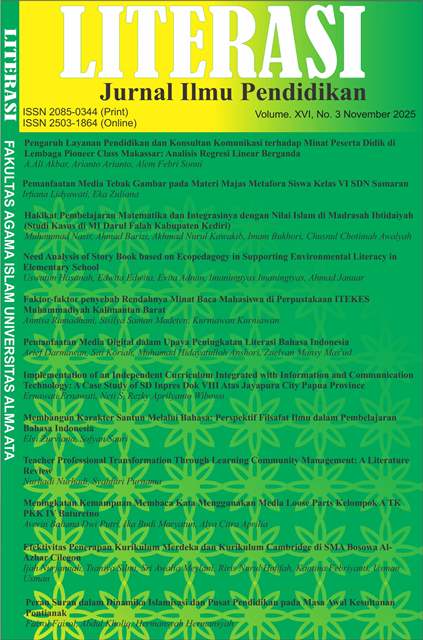
Membangun Karakter Santun Melalui Bahasa: Perspektif Filsafat Ilmu dalam Pembelajaran Bahasa Indonesia
DOI:
https://doi.org/10.21927/literasi.2025.16(3).384-402Abstract
Degradasi komunikasi peserta didik, baik dalam konteks tatap muka maupun virtual, menimbulkan hambatan signifikan dalam bidang penguasaan bahasa dan pembentukan karakter. Berusaha untuk menyelidiki internalisasi prinsip-prinsip literasi bahasa melalui lensa filsafat sains, khususnya berfokus pada ontologi, epistemologi, dan aksiologi. Studi ini dilakukan secara konseptual, menggunakan analisis kerangka kerja yang dikemukakan oleh Brown & Levinson serta Leech dalam konteks pendidikan. Kajian ini dilakukan dengan metode studi pustaka terhadap teori-teori kesantunan dan filsafat ilmu dalam konteks pendidikan. Temuan penelitian menunjukkan bahwa kesatuan linguistik merupakan entitas nilai yang mencakup dimensi budaya dan etika. Perspektif ontologis menjelaskan sifat dasar kepatuhan sebagai aspek integral dari keberadaan sosial, serta perspektif epistemologis mengeksplorasi proses di mana pengetahuan tentang keterikatan bahasa melalui pengalaman pendidikan, sedangkan perspektif aksiologis menggarisbawahi implikasi etis yang melekat dalam penerapan bahasa sopan. Hasil studi ini menjelaskan model akuisisi bahasa yang secara fundamental berorientasi pada nilai-nilai dan pengembangan karakter, yang bertujuan untuk secara konsisten meningkatkan Profil Pelajar Pancasila.
References
Denisenko, V. N., Yergazy, N., & Rybakov, M. A. (2023). Language Means of Expressing Politeness in the Context of Russian Business Communication. RUDN Journal of Language Studies, Semiotics and Semantics, 14(3), 575–594. https://doi.org/10.22363/2313-2299-2023-14-3-575-594
Mambetniyazova, A., Babaeva, G., Dauletbayeva, R., Paluanova, M., & Abishova, G. (2024). Linguistic and cultural analysis of the concept “politeness.†Semiotica, 2024(258), 73–91. https://doi.org/10.1515/sem-2023-0141
Pradita, L. E., Rachmawati, U., Farikah, F., Widyanto, D., Jendriadi, J., & Hananto, I. (2024). Language Politeness in Elementary School Students Learning Activities. Journal of Language and Literature Studies, 4(1), 61–70. https://doi.org/10.36312/jolls.v4i1.1760
Simatupang, M. S., & Naibaho, L. (2021). Language Politeness. Proceedings of the 2nd Annual Conference on Blended Learning, Educational Technology and Innovation (ACBLETI 2020), 166–171. https://doi.org/10.2991/assehr.k.210615.033
Rahayu, E. T., Riyadi, S., Hartati, H., Stovia, A., Roiyasa, N., & Asriyama, W. F. (2023). Language Politeness Education through Language Behaviour Habits: Concerning the Indonesian and Japanese Viewpoints. AL-ISHLAH: Jurnal Pendidikan, 15(2), 2173–2181. https://doi.org/10.35445/alishlah.v15i2.3267
Daulay, S. H., Ningrum, D. W., & Nasution, P. S. (2022). Learning Process of Online Class by Using Language Politeness Principles. Jurnal Ilmiah Peuradeun, 10(2), 403–420. https://doi.org/10.26811/peuradeun.v10i2.699
Sumbayak, L., & Nasution, J. (2022). Analysis of Teachers’ Language Politeness During Teaching English. Jurnal Bahasa Indonesia Prima (BIP), 4(1), 215–225. https://doi.org/10.34012/jbip.v4i1.2613
Hamrakulova, G. (2020). Politeness Theory in Language. Mental Enlightenment Scientific-Methodological Journal, 2020(2), 151–157.
MarÃn, F. J. S. (2022). Inteligencia Social en el marco del Espacio Europeo de Educación Superior. HUMAN REVIEW. International Humanities Review / Revista Internacional de Humanidades, 11(Monográfico), 1–13. https://doi.org/10.37467/revhuman.v11.4091
Meliá, J. M. J., Bakieva, M., & Sánchez-Delgado, P. (2020). La Cohesión Social como Objetivo de la Educación: ¿Podemos Especificar un Modelo de Calidad para Realizar la Evaluación de Sistemas Educativos? Fronteiras: Journal of Social, Technological and Environmental Science, 9(3), 239–260. https://doi.org/10.21664/2238-8869.2020v9i3.p239-260
Sauri, S. (2021). Kesantunan Berbahasa; Kajian Nilai, Moral, Etika, Akhlak, Karakter, dan Manajemen. Royyan Press.
Kusmanto, H., & Widodo, P. (2022). Positive politeness strategies during online learning: A cyberpragmatic study. Studies in English Language and Education, 9(3), 1170–1182. https://doi.org/10.24815/siele.v9i3.24021
Wong, L., & Esler, J. (2020). A Review of Teaching and Learning Linguistic Politeness. Journal of Critical Studies in Language and Literature, 1(4), 13–21. https://doi.org/10.46809/jcsll.v1i4.38
Bardoviâ€Harlig, K. (2023). Pragmatics as a Pedagogical Target. In The Encyclopedia of Applied Linguistics (pp. 1–7). Wiley. https://doi.org/10.1002/9781405198431.wbeal20457
Gesuato, S. (2022). Review: Trubnikova, Victoriya, & Garofolin, Benedetta. (2020). Lingua e interazione. Insegnare la pragmatica a scuola [Language and interaction. Teaching pragmatics at school]. Edizioni ETS. EuroAmerican Journal of Applied Linguistics and Languages, 9(1), 140–144. https://doi.org/10.21283/2376905X.15.271
Malev, A. V., & Gusarova, V. S. (2022). Illocutionary literacy as a reflection of pragmaticon of secondary linguistic personality of a foreign language teacher: discourse semantic and didactic aspects. Tambov University Review. Series: Humanities, 2, 358–367. https://doi.org/10.20310/1810-0201-2022-27-2-358-367
Akter, M. S. (2023). The Effectiveness of Polite Language in Social Behavior. British Journal of Arts and Humanities, 5(1), 1–8. https://doi.org/10.34104/bjah.0230108
Ghosh, P. K. (2022). The Philosophy of Science. In The History and Philosophy of Science (pp. 113–139). Routledge India. https://doi.org/10.4324/9781003033448-10
Mühlenbernd, R., Wacewicz, S., & Żywiczyński, P. (2021). Politeness and reputation in cultural evolution. Linguistics and Philosophy, 44(6), 1181–1213. https://doi.org/10.1007/s10988-020-09315-6
Tarigan, M., Yasmin, F. A., Rifai, A., Yusriani, Y., Azmi, K., & Azmi, K. (2022). Filsafat Ilmu sebagai Landasan Pengembangan Ilmu Pendidikan. Mahaguru: Jurnal Pendidikan Guru Sekolah Dasar, 3(1), 175–182. https://doi.org/10.33487/mgr.v3i1.4049
Bakai, Y., Nanivska, L., Semenets, O., Hetman, Y., & Pryma, V. (2023). The efficiency of language teaching through integration in future philologists’ foreign language competence formation. Revista Amazonia Investiga, 12(61), 297–306. https://doi.org/10.34069/AI/2023.61.01.30
Ginting, D. A., Zaim, M., & Thahar, H. E. (2023). Filsafat Ilmu sebagai Landasan Pengembangan Pendidikan Bahasa. Journal on Education, 5(2), 2881–2887. https://doi.org/10.31004/joe.v5i2.936
Nosita, D., & Rini, S. (2023). Effect of analytic philosophy on english language education. English Language Teaching Journal, 3(1), 1–5. https://doi.org/10.35897/eltj.v3i1.905
Hayati, N., & Dalimunthe, I. S. (2024). The Concept Of Science In Philosophy Review (Study Aspects Of Ontology, Epistemology And Axiology Of Science). Darul Ilmi: Jurnal Ilmu Kependidikan Dan Keislaman, 11(2), 162–178. https://doi.org/10.24952/di.v11i2.10462
Munip, A. (2024). Ilmu dalam Tinjauan Filsafat: Ontologi, Epistemologi, dan Aksiologi. Al-Aulia: Jurnal Pendidikan Dan Ilmu-Ilmu Keislaman, 10(1), 49–58. https://doi.org/10.46963/aulia.v10i1.1875
Rosida, R. F., Amaliah, L. N., Mahardika, I. K., & Suratno, S. (2023). The process of forming knowledge: In the study of ontology, epistemology, and axiology. International Journal for Educational and Vocational Studies, 5(1), 13–18. https://doi.org/10.29103/ijevs.v5i1.12980
Handoko, M. D. (2020). Manajemen Mutu Pendidikan dalam Perspektif Kebijakan Pendidikan Nasional. Dewantara, 9, 35–52. https://doi.org/10.38073/adabuna.v3i1.992
Hidayat, R., Afandi, A., Siregar, M., & Mujiatun, S. (2024). Peran Filsafat Ilmu dalam Meningkatkan Kualitas Penelitian Manajemen: Pendekatan Epistemologi, Ontologi, dan Aksiologi. Jurnal Lentera Bisnis, 13(3), 2155–2171. https://doi.org/10.34127/jrlab.v13i3.1310
Prasanty, A. B., & Darodjat, D. (2024). Ontologi: Membongkar Hakikat Keberadaan dalam Dunia Filsafat. Student Research Journal, 2(5), 8–25. https://doi.org/10.55606/srj-yappi.v2i5.1533
Sauri, S., Firmansyah, H., & Rizal, A. S. (2010). Filsafat Ilmu Pendidikan Agama. CV Arfino Raya.
Suryati, H. (2025). Epistemologi Ilmu: Landasan Filsafat dalam Pengembangan Pengetahuan. Journal of Innovation in Teaching and Instructional Media, 5(2), 626–638. https://doi.org/10.52690/jitim.v5i2.987
Antonovskiy, A. Y., & Barash, R. E. (2022). How social ontology is possible from the point of view of epistemology and philosophy of language? RUDN Journal of Philosophy, 26(3), 607–622. https://doi.org/10.22363/2313-2302-2022-26-3-607-622
Malshina, N. (2020). The ontological rootedness of cognitive practices linguistic forms in religious socio-cultural traditions: a comparative approach. Communicology, 8(3), 138–148. https://doi.org/10.21453/2311-3065-2020-8-3-138-148
Matthews, W. (2023). Getting Our Ontology Right: A Critique of Language and Culture in the Work of François Jullien. Theory, Culture & Society, 40(4–5), 75–92. https://doi.org/10.1177/02632764221147664
Barger, M. M., Perez, T., Canelas, D. A., & Linnenbrink-Garcia, L. (2018). Constructivism and personal epistemology development in undergraduate chemistry students. Learning and Individual Differences, 63, 89–101. https://doi.org/10.1016/j.lindif.2018.03.006
Boon, M., Orozco, M., & Sivakumar, K. (2022). Epistemological and educational issues in teaching practice-oriented scientific research: roles for philosophers of science. European Journal for Philosophy of Science, 12(1), 16. https://doi.org/10.1007/s13194-022-00447-z
Kulsum, U. (2020). Epistemologi Islam Dalam Tinjauan Filosofis. Urwatul Wutsqo: Jurnal Studi Kependidikan Dan Keislaman, 9(2), 229–241. https://doi.org/10.54437/urwatulwutsqo.v9i2.185
MejÃas, Y. C. M. (2018). EpistemologÃa y PedagogÃa… Consideraciones. Revista Scientific, 3(9), 362–372. https://doi.org/10.29394/Scientific.issn.2542-2987.2018.3.9.20.362-372
Rizvi, S. (2020). Epistemology according to Allamah Tabatabai. Kom : Casopis Za Religijske Nauke, 9(2), 27–50. https://doi.org/10.5937/kom2001027R
Karimullah, S. S. (2023). Actualization of Pancasila as an Integrative Paradigm in Forming Imagination and Creativity. Pancasila: Jurnal Keindonesiaan, 3(1), 11–21. https://doi.org/10.52738/pjk.v3i1.141
Kuznetsova, I., Mukhamejanova, G., Tuimebayev, Z., Myrzaliyeva, S., & Aldasheva, K. (2024). Axiological approach as a factor of university curriculum language. XLinguae, 17(2), 268–279. https://doi.org/10.18355/XL.2024.17.02.18
Pardosi, M. T. (2024). Actualization The Values Of Pancasila Philosophy In School: Study Of Implementation In The Curriculum And Learning To Build Student Character. JETL (Journal of Education, Teaching and Learning), 9(1), 28. https://doi.org/10.26737/jetl.v9i1.4289
Sarnita, F., Suastra, I. W., & Tungga Atmaja, A. W. (2024). Axiological Analysis of the Driving Teacher’s Perspective in Educational Philosophy on the Profile of Pancasila at SMAN 2 Kota Bima. JISIP (Jurnal Ilmu Sosial Dan Pendidikan), 8(2), 900–905. https://doi.org/10.58258/jisip.v8i2.6566
Za, T., Walidin, W., Idris, S., & Huda, M. (2024). Pancasila as the Core Value for Character Building in Islamic Higher Education Institutions. Jurnal Ilmiah Peuradeun, 12(2), 565–592. https://doi.org/10.26811/peuradeun.v12i2.1212
Huda, S., Sarifudin, M., Munifah, M., Humaidi, A., Idris, S., & Mawardi, M. (2022). The Concept of Character Learning: A Comparative Study of Al-Ghazali and Thomas Lickona’s Perspectives. DAYAH: Journal of Islamic Education, 5(1), 35–52. https://doi.org/10.22373/jie.v5i1.11974
Abdushelishvili, L. (2023). Linguistic-communicative aspects of strategic communication. Enadakultura, 29, 367–381. https://doi.org/10.52340/lac.2023.01
Jary, M. (2022). Linguistic Communication Proper. In Nothing Is Said (pp. 49–85). Oxford University PressOxford. https://doi.org/10.1093/oso/9780192863188.003.0004
Saifudin, A. (2020). Kesantunan Bahasa dalam Studi Linguistik Pragmatik. Lite, 16(2), 135–159. http://scioteca.caf.com/bitstream/handle/123456789/1091/RED2017-Eng-8ene.pdf?sequence=12&isAllowed=y%0Ahttp://dx.doi.org/10.1016/j.regsciurbeco.2008.06.005%0Ahttps://www.researchgate.net/publication/305320484_SISTEM_PEMBETUNGAN_TERPUSAT_STRATEGI_MELESTARI
Wulandari, E. R., & Putra, D. A. K. (2025). Realisasi Prinsip Kesantunan dalam Podcast Vindes Bersama Bernadya. Bestari: Jurnal Bahasa Dan Sastra Indonesia Serta Pengajarannya, 3(1), 338–350.
Dimitriu, A. (2023). Linguistic approaches to development pragmatic communication skills in the English language to students from technical vocational education. Studia Universitatis Moldaviae. Seria Științe Ale Educației, 5(165), 53–58. https://doi.org/10.59295/sum5(165)2023_09
Koknova, T. A. (2022). Linguistic and methodological competence of foreign language teachers (professionall characteristic). Bulletin of Luhansk Taras Shevchenko National University, 2 (350), 131–138. https://doi.org/10.12958/2227-2844-2022-2(350)-131-138
Muminova, A. (2020). The importance of linguistic competence in teaching process. Eurasian Union Scientists, 8(5), 57–58. https://doi.org/10.31618/ESU.2413-9335.2020.8.74.787
Vedder, I. (2020). Competenza linguistica, competenza pragmatica e competenza interazionale nelle proteste di apprendenti di italiano lingua seconda. LinguaDue Italiano, 12(2), 201–214. https://doi.org/https://doi.org/10.13130/2037-3597/15065
Assaf, H. A., & Saeed, Y. S. (2022). The Influence of the Pragmatism Philosophy on Linguistics. Journal of University of Raparin, 9(5), 313–337. https://doi.org/10.26750/Vol(9).No(5).Paper15
Minyar-Belorucheva, A., & Sergienko, P. (2023). Linguistic Approach to the Axiological Sphere of Language and Culture Research in the Modern Communication Studies. Scientific Research and Development. Modern Communication Studies, 12(2), 15–19. https://doi.org/10.12737/2587-9103-2023-12-2-15-19
Vize, C. E., & Lynam, D. R. (2020). Merging Structural and Process–Related Approaches to the Study of Agreeableness: A Preregistered Replication and Extension Attempt. European Journal of Personality, 34(2), 139–163. https://doi.org/10.1002/per.2241
Morgan, T., Wiles, J., Park, H.-J., Moeke-Maxwell, T., Dewes, O., Black, S., Williams, L., & Gott, M. (2021). Social connectedness: what matters to older people? Ageing and Society, 41(5), 1126–1144. https://doi.org/10.1017/S0144686X1900165X
Pertiwi, Y. W., Hutahaean, E. S. H., Perdini, T. A., & Novitasari, F. (2022). Mapping the Construct of Obedience in Education. International Journal of Multicultural and Multireligious Understanding, 9(12), 308–315. https://doi.org/10.18415/ijmmu.v9i12.4233
Sayogie, F. (2022). Framing Face-Saving Behavior on Facebook. International Journal of Media and Information Literacy, 7(2), 554–559. https://doi.org/10.13187/ijmil.2022.2.554
Susandi, A., Zamzani, Z., Prabowo, M., & Yulianto, B. (2024). Portrait of students’ language politeness in elementary school. International Journal of Evaluation and Research in Education (IJERE), 13(1), 141–149. https://doi.org/10.11591/ijere.v13i1.24872
Apdillah, D., Harmika, Z., Sahera, M., & Harahap, H. U. (2022). Communication ethics as virtual virtue control in media behavior society in the digital age. Journal Of Humanities, Social Sciences and Business (JHSSB), 1(3), 49–60. https://doi.org/10.55047/jhssb.v1i3.148
Ibrahim, I. M., & Bakir, S. N. (2021). Generosity Maxim in Leech’s Theory in Pshdar Area: Socio-Pragmatic Perspective. Journal of University of Raparin, 8(2), 81–102. https://doi.org/10.26750/Vol(8).No(2).Paper4
Nabila, I., & Heryono, H. (2025). Politeness Principles in “Murder On The Orient Express†Film: A Pragmatic Study. JALL (Journal of Applied Linguistics and Literacy), 9(1), 97–116. https://doi.org/10.25157/jall.v9i1.18027
Puspawati, A. (2025). Analysis of Politeness Maxims in Indonesian Language Use in College Environments. Romeo Review of Multidiciplinary Education, Culture, and Pedagogy, 4(2), 80–89. https://doi.org/10.55047/romeo.v4i2.1625
Kurniawan, D., & Rambe, A. H. (2024). Implementation of Character Education Through Indonesian Language Learning in Elementary Schools. Scaffolding: Jurnal Pendidikan Islam Dan Multikulturalisme, 6(3), 1–12. https://doi.org/10.37680/scaffolding.v6i3.6166
Santoso, T., Sujianto, D., Afianto, D., Saputro, D., Sabardila, A., Fauziati, E., & Markhamah, D. (2020). Character Education Values in Revised Edition of the Indonesian Language Learning Curriculum for Year 10. Universal Journal of Educational Research, 8(2), 417–424. https://doi.org/10.13189/ujer.2020.080212
Jannah, M., Anshori, R. al, Istiadah, I., & Huda, M. (2024). Arabic Language Learning in The Merdeka Curriculum From the Perspective of Progressivism Philosophy. Lisanudhad: Jurnal Bahasa, Pembelajaran, Dan Sastra Arab, 11(1), 32–51. https://doi.org/10.21111/lisanudhad.v11i01.10787
Kharimah, I., Siminto, S., & Qamariah, Z. (2023). The Implementation Of Merdeka Curriculum For Formal English Learning. Atmosfer: Jurnal Pendidikan, Bahasa, Sastra, Seni, Budaya, Dan Sosial Humaniora, 1(3), 52–65. https://doi.org/10.59024/atmosfer.v1i3.206
Muhsyanur, M. (2024). Implementation of Merdeka Belajar in Indonesian Language Learning in Senior High Schools. Jurnal Ilmiah Insan Mulia, 1(1), 8–14. https://doi.org/10.59923/jiim.v1i1.170
Rintaningrum, R., Fahmi, A., Nuswantara, K., Trisyanti, U., Yusuf, K., & Zahrok, S. (2023). Strengthening English Language Learning Through an Independent Curriculum Approach. International Journal of Science and Society, 5(5), 161–171. https://doi.org/10.54783/ijsoc.v5i5.875
Hua, H. H., & Le, T. T. (2024). Enhancing Learner Autonomy and Cultural Awareness: Strategies of Vietnamese Tertiary-Level EFL Teachers. European Journal of Educational Research, 13(4), 1519–1534. https://doi.org/10.12973/eu-jer.13.4.1519
Yang, S.-H., & Yeh, H.-C. (2021). Enhancing EFL learners’ intracultural development as cultural communicators through YouTube video-making. Technology, Pedagogy and Education, 30(4), 557–572. https://doi.org/10.1080/1475939X.2021.1925336
Koh, E. T., & Owen, W. L. (2000). Descriptive Research and Qualitative Research. In Introduction to Nutrition and Health Research (pp. 219–248). Springer US. https://doi.org/10.1007/978-1-4615-1401-5_12
Suarez, D. (2010). Evaluating Qualitative Research Studies for Evidence Based Library and Information Practice. Evidence Based Library and Information Practice, 5(2), 75–85. https://doi.org/10.18438/B8V90M
Kara, H. (2023). Secondary data. In Research and Evaluation for Busy Students and Practitioners (pp. 123–134). Policy Press. https://doi.org/10.51952/9781447366263.ch008
Manu, E., Akotia, J., Sarhan, S., & Mahamadu, A.-M. (2021). Identifying and sourcing data for secondary research. In Secondary Research Methods in the Built Environment (pp. 16–25). Routledge. https://doi.org/10.1201/9781003000532-2
Cano, L., Hein, E., Rada-Orellana, M., & Ortega, C. (2019). A Case Study of Library Data Management: A New Method to Analyze Borrowing Behavior. In Information Management and Big Data (pp. 112–120). https://doi.org/10.1007/978-3-030-11680-4_12
Kilubi, I. (2018). Research methodology and data collection. In Strategic Technology Partnering and Supply Chain Risk Management (pp. 79–89). Springer Fachmedien Wiesbaden. https://doi.org/10.1007/978-3-658-19918-0_8
Monsen, K. A. (2018). Descriptive Analysis and Interpretation. In Intervention Effectiveness Research: Quality Improvement and Program Evaluation (pp. 53–62). Springer International Publishing. https://doi.org/10.1007/978-3-319-61246-1_5
Maxwell, G. S. (2021). Validity Considerations in Data Collection and Use. In Using Data to Improve Student Learning (pp. 143–183). https://doi.org/10.1007/978-3-030-63539-8_5
Noble, H., & Heale, R. (2019). Triangulation in research, with examples. Evidence Based Nursing, 22(3), 67–68. https://doi.org/10.1136/ebnurs-2019-103145
Gultom, M. A. B., & Rahmadini, N. F. (2022). The Relation of the Use of Language in Social Media to Politeness Among Students (pp. 1–13). https://doi.org/10.31219/osf.io/dq8wy
Fatić, A. (2021). The Epistemic Value of Politeness as a Virtue. In The Philosophy of (Im) Politeness (pp. 115–136). https://doi.org/10.1007/978-3-030-81592-9_7
Isosävi, J. (2020). Cultural outsiders’ reported adherence to Finnish and French politeness norms. Journal of Pragmatics, 155, 177–192. https://doi.org/10.1016/j.pragma.2019.10.015
Trubnikova, V. (2023). Conceptualization of first-order politeness in Russia: an exploratory study. Journal of Politeness Research, 19(2), 391–414. https://doi.org/10.1515/pr-2021-0042
Syting, C. J. O., & Gildore, P. J. E. (2022). Teachers’ Linguistic Politeness in Classroom Interaction: A Pragmatic Analysis. World Journal of English Language, 12(8), 133–141. https://doi.org/10.5430/wjel.v12n8p133
Aporbo, R. J., Barabag, J. M. C., Catig, B. U., & Claveria, C. M. P. (2024). Face-threatening and Face-saving Speech Acts of Teachers: A Discourse Analysis of Classroom Interactions. World Journal of English Language, 14(3), 413–439. https://doi.org/10.5430/wjel.v14n3p413
Malovana, N., & Yusiuk, A. (2020). Face saving aspects in intercultural communication. Vìsnik Marìupolʹsʹkogo Deržavnogo Unìversitetu. Serìâ: Fìlologìâ, 13(22), 189–196. https://doi.org/10.34079/2226-3055-2020-13-22-189-196
Alief, K., & Nashruddin, N. (2022). Application of Language Politeness in Learning Activities at School. JELITA, 3(1), 1–11. https://doi.org/10.56185/jelita.v3i1.93
Mugford, G. (2022). Politeness in professional contexts: foreign-language teacher training. Journal of Politeness Research, 18(1), 151–172. https://doi.org/10.1515/pr-2020-0006
Hwang, J. young. (2024). Cross-cultural communication in global business. GSC Advanced Research and Reviews, 21(3), 457–469. https://doi.org/10.30574/gscarr.2024.21.3.0481
Tanduk, R. (2023). Pragmatic Aspects of Speech Acts: A Cross-Linguistic Perspective. English Review: Journal of English Education, 11(3). https://doi.org/10.25134/erjee.v11i3.8762
Kyriakopoulou, N., & Vosniadou, S. (2020). Theory of Mind, Personal Epistemology, and Science Learning: Exploring Common Conceptual Components. Frontiers in Psychology, 11, 1–15. https://doi.org/10.3389/fpsyg.2020.01140
Sihombing, N. A., & Sauri, S. (2021). Sociolinguistic Epistemology and Its Implications in Learning Indonesian Language at School. SeBaSa, 4(1), 53–66. https://doi.org/10.29408/sbs.v4i1.2960
Anwar, M., Amir, F. R., Herlina, H., Anoegrajekti, N., & Muliastuti, L. (2021). Language Impoliteness among Indonesians on Twitter. Jurnal Komunikasi: Malaysian Journal of Communication, 37(4), 161–176. https://doi.org/10.17576/JKMJC-2021-3704-10
Rega, R., Marchetti, R., & Stanziano, A. (2023). Incivility in Online Discussion: An Examination of Impolite and Intolerant Comments. Social Media + Society, 9(2), 1–12. https://doi.org/10.1177/20563051231180638
Sauri, S., & Sanusi, A. (2025). Investigating Teacher Performance in Character Building Students: a Case Study of Teaching and Learning at an Elementary School in Indonesia. Journal of Lifestyle and SDGs Review, 5(1), e03829. https://doi.org/10.47172/2965-730X.SDGsReview.v5.n01.pe03829
Subyantoro, Suseno, Zuliyanti, & Fadilya Diani Putri, S. (2023). Impoliteness Strategy for Cyberbullying in Indonesian on Instagram Social Media. KEMBARA Journal of Scientific Language Literature and Teaching, 9(2), 735–749. https://doi.org/10.22219/kembara.v9i2.25517
Salimi, E. A., & Mortazavi, S. M. (2023). “I Keep Forgetting You’re Still Aliveâ€: Unmasking Impoliteness in the Xsphere. Language Teaching Research Quarterly, 38, 18–33. https://doi.org/10.32038/ltrq.2023.38.02
Santoso, T., Nurhayati, E., & Margana. (2025). Indonesian Netizens’ Impoliteness Toward Government Loudspeaker Policies: A Cyberpragmatic Approach. Journal of Language Teaching and Research, 16(2), 604–616. https://doi.org/10.17507/jltr.1602.27
Mishra, K., Firdaus, M., & Ekbal, A. (2023). Predicting Politeness Variations in Goal-Oriented Conversations. IEEE Transactions on Computational Social Systems, 10(3), 1095–1104. https://doi.org/10.1109/TCSS.2022.3156580
Zhang, S., Mingyue Gu, M., Sun, W., & Jin, T. (2024). Digital literacy competence, digital literacy practices and teacher identity among pre-service teachers. Journal of Education for Teaching, 50(3), 464–478. https://doi.org/10.1080/02607476.2023.2283426
Adriyanti, K. Y. (2021). Implementation of Character Education in Teaching English For Young Learners. The Art of Teaching English as a Foreign Language, 2(1), 17–23. https://doi.org/10.36663/tatefl.v1i2.98
Indrayanti, T. (2022). Strategi Kesantunan Berbahasa dalam Talk Show dan Relevansinya Terhadap Pembelajaran Bahasa Indonesia Tingkat SMP. Buana Bastra, 6(2), 1–12. https://doi.org/10.36456/bastra.vol6.no2.a5034
Mujiburrohman, M., & Widyaningsih, E. (2025). Perspektif Ontologi Islam dalam Pembentukan Karakter Siswa di SD Negeri 02 Karang. Asian Journal of Early Childhood and Elementary Education, 3(1), 70–82. https://doi.org/10.58578/ajecee.v3i1.4647
Yusup, A., & Jannah, R. (2024). The Role of Education in the Formation of Social Character in a Multicultural Society. International Journal of Social and Human, 1(1), 1–7. https://doi.org/10.59613/30r6jp04
Farayanti, D., Suparni, S., & Syamsuddin, S. (2024). Linguistic Politeness in Indonesian Language Learning Interactions: A Pragmatic Analysis Based on Leech’s Principles. Applied Linguistics: Innovative Approaches and Emerging Trends, 1(2), 175–191. https://doi.org/10.58989/appling.v1i2.30
Irwansyah, D. (2018). Teaching English at Indonesian Islamic Higher Education: An Epistemological Perspective. Dinamika Ilmu, 18(1), 1–13. https://doi.org/10.21093/di.v18i1.1120
Islami, N. I., & Sauri, S. (2022). Konsep Positivisme dalam Pembelajaran Bahasa Indonesia di Era Merdeka Belajar. GHANCARAN: Jurnal Pendidikan Bahasa Dan Sastra Indonesia, 97–107. https://doi.org/10.19105/ghancaran.vi.7449
Guo, B. (2024). The axiological contexts and perspectives in language studying. Higher Education: Traditions, Values, Perspectives: Proceedings of the International Scientific Conference, 375–379. https://doi.org/10.46727/c.27-28-09-2024.p375-379
Saleh, M. (2024). Integrating Religious Values into Indonesian Language Learning: Pedagogical Approaches and Impacts. Global International Journal of Innovative Research, 2(8), 1806–1813. https://doi.org/10.59613/global.v2i8.269
Bayurini, D. S., Sauri, S., & Hikamudin, E. (2024). Pedagogical Study in Character Development to Increase the Moral Awareness of Students in Schools. Proceeding of International Conference on Education, Language, Literacies, and Literary Studies (ICONELS, 1, 81–89.
Sauri, S., & Sanusi, A. (2024). Assessing of Pedagogical Competency of Prospective Teachers in Teaching Arabic in Schools: Suitable or Not Suitable? Journal of Ecohumanism, 3(7), 2509–2518. https://doi.org/10.62754/joe.v3i7.4653
Syaiful, R., Mochammad, N., & Amrozi, K. (2024). Meaningful Learning in Philosophical Perspective: A Review of Ontology, Epistemology, and Axiology. Journal of Education Technology and Inovation, 7(2), 89–94. https://doi.org/10.31537/jeti.v7i2.2152
Amir, I., Nursalam, N., & Mustafa, I. (2022). Tantangan Implementasi Nilai-Nilai Profil Pelajar Pancasila dalam Pembelajaran Bahasa Indonesia pada Kurikulum Merdeka Belajar. GHANCARAN: Jurnal Pendidikan Bahasa Dan Sastra Indonesia, 204–215. https://doi.org/10.19105/ghancaran.vi.7587
Prayitno, H. J., Markhamah, Nasucha, Y., Huda, M., Ratih, K., Ubaidullah, Rohmadi, M., Boeriswati, E., & Thambu, N. (2022). Prophetic educational values in the Indonesian language textbook: pillars of positive politeness and character education. Heliyon, 8(8), e10016. https://doi.org/10.1016/j.heliyon.2022.e10016
Syafitri, M. (2023). Analysis of Pancasila Learner Profile Values in Indonesian Language Learning Book Texts. Aksis : Jurnal Pendidikan Bahasa Dan Sastra Indonesia, 7(2), 186–199. https://doi.org/10.21009/AKSIS.070207
Sumaryamti, S. (2023). Inovasi Pembelajaran Bahasa Indonesia Dalam Kurikulum Merdeka Belajar Untuk Mewujudkan Profil Pelajar Pancasila. Jurnal Indonesia Sosial Teknologi, 4(1), 47–55. https://doi.org/10.36418/jist.v4i1.564
Fauziah, F. N., Saddhono, K., & Suryanto, E. (2023). Implementation of Local Wisdom-Based Indonesian Learning to Strengthen Pancasila Student Profiles (P5): Case Studies in Vocational High Schools. Journal of Curriculum and Teaching, 12(6), 283–297. https://doi.org/10.5430/jct.v12n6p283
Wardana, M. A. W., Saddhono, K., & Suhita, R. (2022). Kesantunan Berbahasa sebagai Implementasi Pendidikan Karakter pada Pembelajaran di SMP PGRI 2 Wates Kabupaten Blitar: Kajian Sosiolinguistik Alih Kode dan Campur Kode. Jurnal Pendidikan Sosiologi Dan Humaniora, 13(2), 606–613. https://doi.org/10.26418/j-psh.v13i2.57904
Downloads
Published
Issue
Section
License
Authors who publish with this journal agree to the following terms:
1. Authors retain copyright and grant the journal right of first publication, with the work [SPECIFY PERIOD OF TIME] after publication simultaneously licensed under a Creative Commons Attribution License that allows others to share the work with an acknowledgement of the work's authorship and initial publication in this journal.
Â
2. Authors are able to enter into separate, additional contractual arrangements for the non-exclusive distribution of the journal's published version of the work (e.g., post it to an institutional repository or publish it in a book), with an acknowledgement of its initial publication in this journal.
Â
3. Authors are permitted and encouraged to post their work online (e.g., in institutional repositories or on their website) prior to and during the submission process, as it can lead to productive exchanges, as well as earlier and greater citation of published work (See The Effect of Open Access).
Â

LITERASI by http://ejournal.almaata.ac.id/index.php/LITERASI is licensed under a Creative Commons Attribution-ShareAlike 4.0 International License.