
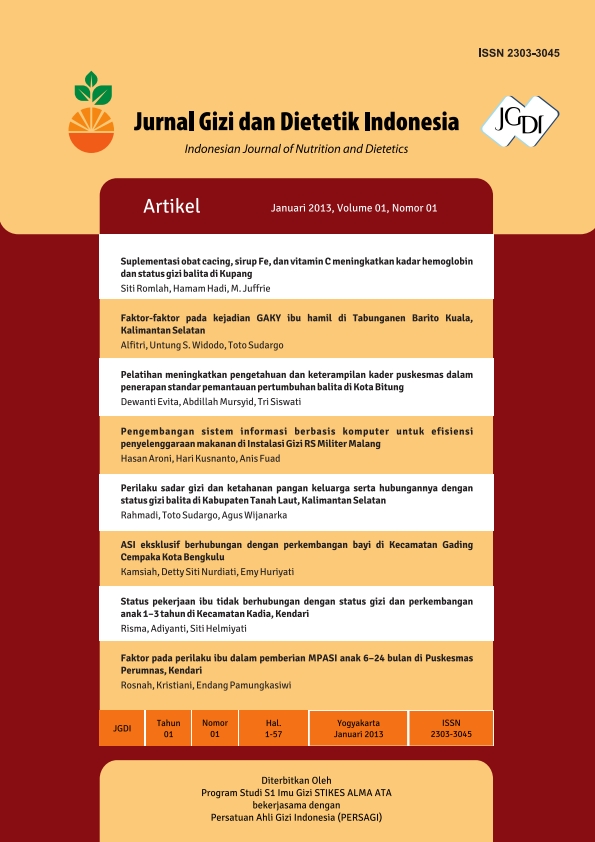
Faktor pada perilaku Ibu dalam pemberian MPASI anak 6–24 bulan di Puskesmas Perumnas, Kendari
Article Sidebar
Submitted
9 March 2016
Accepted
9 March 2016
Published
9 March 2016
Abstract
ABSTRACT
Background: The problem of growth among underï¬ ves in Indonesia is related to the number of infants that are given
complementary feeding since the age of one month. It infl uenced the prevalence of undernourishment 3.25% and
malnutritionat District of Kadia become higher. Those nutrition problem can be affected by inability to provide foods as
needed by members of the family, knowledge and behavior of the family in food selection, cook and distribute the food
in the family. Another problem is lack of mothers' attention to monitor the child growth and development
Objective: To study the factors associated with mothers' behavior in the supply of complementary breastfeeding to
infants of 6–24 months at Perumnas Health Center Subdistrict of Kadia Kendari Municipality.
Method: This analytical study used a cross sectional design and quantitative and qualitative method. Subject were mothers'
of underï¬ ves who fulï¬ lled inclusion criteria at the working area of Perumnas Health Center District of Kadia Kendari
Municipality. Samples were taken using simple random sampling technique. Research instruments were questionnaire
and indepth interview guide. Data analysis used chi square and double logistic regression test. Qualitative data were
analyzed manually and presented in narration.
Result: Predisposition factors signiï¬ cantly associated with mothers' behavior in the supply of complementary breastfeeding
were mothers' education (p=0.025; OR=3.27), family income (p=0.007; OR=4.65), knowledge of mothers (p=0.05;
OR=2.75), and mothers' attitude (p=0.027; OR=2.92). Another supporting factor, i.e. participation of mothers in the
integrated service post (posyandu) was signiï¬ cantly associated with behavior in the supply of complementary breastfeeding
(p=0.008; OR=3.65). Encouraging factors associated with the behavior of mother in the supply of complementary
breastfeeding were support of the health staff (p=0.005; OR=4.21) and the family (p=0.041; OR=4.22).
Conclusion: The result of multivariate analysis showed that the factor most dominantly associated with the behavior in
the supply of complementary breastfeeding was education of mothers (p=0.012; OR=5,40).
KEYWORDS: behavior, complementary breastfeeding, infants of 6 – 24 months
ABSTRAK
Latar Belakang: Masalah gangguan pertumbuhan balita di Indonesia berkaitan dengan banyaknya bayi yang sudah
diberi makanan pendamping ASI (MPASI) sejak usia kurang dari atau 1 bulan. Hal ini mengakibatkan prevalensi gizi
kurang dan buruk di Kecamatan Kadia cukup tinggi. Masalah gizi ini dipengaruhi oleh tingkat kemampuan menyediakan
pangan sesuai dengan kebutuhan anggota keluarga, pengetahuan dan perilaku keluarga dalam memilih, mengolah,
dan membagi makanan di tingkat rumah tangga. Permasalahan lain kurangnya perhatian ibu untuk memantau tumbuh
kembang balitanya.
Tujuan: Mengetahui faktor-faktor yang berhubungan dengan perilaku ibu dalam pemberian MPASI pada anak usia
6-24 bulan di Puskesmas Perumnas Kecamatan Kadia, Kota Kendari.
Metode: Jenis penelitian ini adalah analitik dengan rancangan cross sectional, menggunakan metode kuantitatif dan
kualitatif. Subjek adalah ibu balita yang memenuhi kriteria inklusi di wilayah kerja Puskesmas Perumnas Kecamatan
Kadia, Kota Kendari. Jumlah sampel sebanyak 97 subjek. Pengambilan sampel secara simple random sampling. Data
dikumpulkan dengan panduan wawancara mendalam dan dianalisis dengan Chi-Square dan uji regresi logistik berganda.
Data kualitatif dianalisis secara manual dan disajikan dalam bentuk narasi.
Hasil: Dari faktor-faktor predisposisi, yang mempunyai hubungan bermakna dengan perilaku ibu dalam pemberian MPASI
adalah pendidikan ibu (p=0,025; RP = 3,27), pendapatan per kapita keluarga (p=0,007; RP = 4,65), pengetahuan ibu
(p= 0,05; RP= 2,75), dan sikap ibu (p = 0,027; RP=2,92) dengan perilaku pemberian MPASI. Dari faktor pendukung,
partisipasi ibu ke posyandu mempunyai hubungan bermakna dengan perilaku pemberian MPASI (p=0,008; RP=3,65),
sedangkan dari faktor pendorong yang berhubungan dengan perilaku ibu dalam pemberian MPASI adalah dukungan
petugas kesehatan (p=0,005; RP=4,21) dan dukungan keluarga (p=0,041; RP=4,22). Kesimpulan: Dari hasil analisis multivariat diperoleh hasil bahwa faktor paling dominan yang berhubungan dengan
perilaku pemberian MPASI adalah pendidikan ibu (p=0,015; RP= 5,40).
KATA KUNCI: perilaku, pemberian MPASI, anak usia 6-24 bulan.
Background: The problem of growth among underï¬ ves in Indonesia is related to the number of infants that are given
complementary feeding since the age of one month. It infl uenced the prevalence of undernourishment 3.25% and
malnutritionat District of Kadia become higher. Those nutrition problem can be affected by inability to provide foods as
needed by members of the family, knowledge and behavior of the family in food selection, cook and distribute the food
in the family. Another problem is lack of mothers' attention to monitor the child growth and development
Objective: To study the factors associated with mothers' behavior in the supply of complementary breastfeeding to
infants of 6–24 months at Perumnas Health Center Subdistrict of Kadia Kendari Municipality.
Method: This analytical study used a cross sectional design and quantitative and qualitative method. Subject were mothers'
of underï¬ ves who fulï¬ lled inclusion criteria at the working area of Perumnas Health Center District of Kadia Kendari
Municipality. Samples were taken using simple random sampling technique. Research instruments were questionnaire
and indepth interview guide. Data analysis used chi square and double logistic regression test. Qualitative data were
analyzed manually and presented in narration.
Result: Predisposition factors signiï¬ cantly associated with mothers' behavior in the supply of complementary breastfeeding
were mothers' education (p=0.025; OR=3.27), family income (p=0.007; OR=4.65), knowledge of mothers (p=0.05;
OR=2.75), and mothers' attitude (p=0.027; OR=2.92). Another supporting factor, i.e. participation of mothers in the
integrated service post (posyandu) was signiï¬ cantly associated with behavior in the supply of complementary breastfeeding
(p=0.008; OR=3.65). Encouraging factors associated with the behavior of mother in the supply of complementary
breastfeeding were support of the health staff (p=0.005; OR=4.21) and the family (p=0.041; OR=4.22).
Conclusion: The result of multivariate analysis showed that the factor most dominantly associated with the behavior in
the supply of complementary breastfeeding was education of mothers (p=0.012; OR=5,40).
KEYWORDS: behavior, complementary breastfeeding, infants of 6 – 24 months
ABSTRAK
Latar Belakang: Masalah gangguan pertumbuhan balita di Indonesia berkaitan dengan banyaknya bayi yang sudah
diberi makanan pendamping ASI (MPASI) sejak usia kurang dari atau 1 bulan. Hal ini mengakibatkan prevalensi gizi
kurang dan buruk di Kecamatan Kadia cukup tinggi. Masalah gizi ini dipengaruhi oleh tingkat kemampuan menyediakan
pangan sesuai dengan kebutuhan anggota keluarga, pengetahuan dan perilaku keluarga dalam memilih, mengolah,
dan membagi makanan di tingkat rumah tangga. Permasalahan lain kurangnya perhatian ibu untuk memantau tumbuh
kembang balitanya.
Tujuan: Mengetahui faktor-faktor yang berhubungan dengan perilaku ibu dalam pemberian MPASI pada anak usia
6-24 bulan di Puskesmas Perumnas Kecamatan Kadia, Kota Kendari.
Metode: Jenis penelitian ini adalah analitik dengan rancangan cross sectional, menggunakan metode kuantitatif dan
kualitatif. Subjek adalah ibu balita yang memenuhi kriteria inklusi di wilayah kerja Puskesmas Perumnas Kecamatan
Kadia, Kota Kendari. Jumlah sampel sebanyak 97 subjek. Pengambilan sampel secara simple random sampling. Data
dikumpulkan dengan panduan wawancara mendalam dan dianalisis dengan Chi-Square dan uji regresi logistik berganda.
Data kualitatif dianalisis secara manual dan disajikan dalam bentuk narasi.
Hasil: Dari faktor-faktor predisposisi, yang mempunyai hubungan bermakna dengan perilaku ibu dalam pemberian MPASI
adalah pendidikan ibu (p=0,025; RP = 3,27), pendapatan per kapita keluarga (p=0,007; RP = 4,65), pengetahuan ibu
(p= 0,05; RP= 2,75), dan sikap ibu (p = 0,027; RP=2,92) dengan perilaku pemberian MPASI. Dari faktor pendukung,
partisipasi ibu ke posyandu mempunyai hubungan bermakna dengan perilaku pemberian MPASI (p=0,008; RP=3,65),
sedangkan dari faktor pendorong yang berhubungan dengan perilaku ibu dalam pemberian MPASI adalah dukungan
petugas kesehatan (p=0,005; RP=4,21) dan dukungan keluarga (p=0,041; RP=4,22). Kesimpulan: Dari hasil analisis multivariat diperoleh hasil bahwa faktor paling dominan yang berhubungan dengan
perilaku pemberian MPASI adalah pendidikan ibu (p=0,015; RP= 5,40).
KATA KUNCI: perilaku, pemberian MPASI, anak usia 6-24 bulan.
Authors
Copyright and license info is not available