
Sociodemographic Factors on Aspects of Knowledge, Belief, Attitude, and Practice of Antibiotic Use Among the Community in Bandar Lampung City, Indonesia
Article Sidebar
-
Anti-Bacterial Agents; Beliefs; Health Knowledge, Attitudes, Practice; Self Medication; Socioeconomic Factors
Abstract
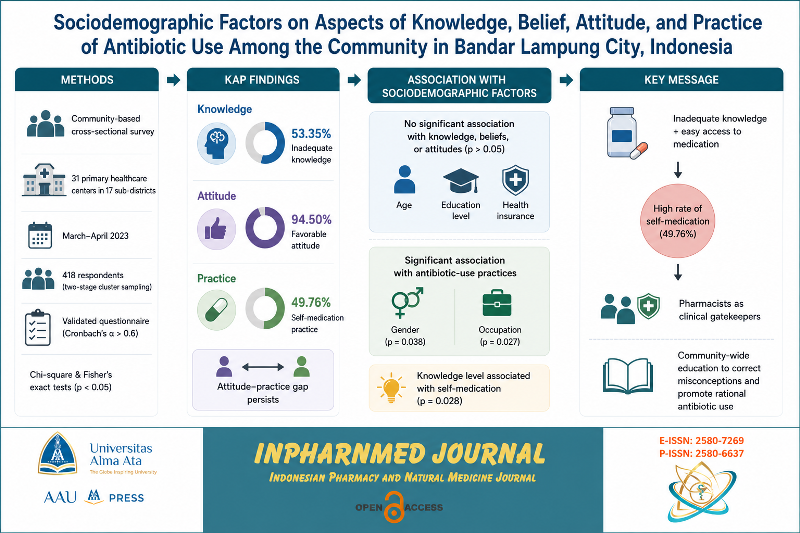
Background: Antibiotic resistance (AMR) is a critical global health threat, often exacerbated by inappropriate self-medication. In Indonesia, infectious diseases remain a leading cause of mortality, yet public understanding of and practices regarding antibiotic use are often suboptimal. Objective: This study investigated the association between sociodemographic factors and knowledge, beliefs, attitudes, and practices (KAP) regarding antibiotic use in the community in Bandar Lampung, Indonesia. Methods: A community-based cross-sectional survey was conducted from March to April 2023 across 31 primary healthcare centers in 17 sub-districts. A total of 418 respondents were selected using a two-stage cluster sampling method. Data were collected using a validated questionnaire (Cronbach’s alpha > 0.6) and analyzed using Chi-square and Fisher’s exact tests (p<0.05). Results: The findings showed that 53.35% of respondents had inadequate knowledge, and 49.76% practiced self-medication. Although 94.50% held favorable attitudes toward rational use, a notable "attitude-practice gap" persisted. Statistical analysis found that sociodemographic factors, including age, education level, and health insurance, were not significantly associated with knowledge, beliefs, or attitudes (p>0.05), indicating that misconceptions were uniformly distributed across the community. However, antibiotic-use practices were significantly associated with gender (p=0.038) and occupation (p=0.027). Furthermore, knowledge levels were significantly associated with self-medication practices (p=0.028), identifying inadequate health literacy as a primary driver of inappropriate drug acquisition. Conclusion: Although theoretical attitudes were positive, inadequate knowledge and easy access to medication fueled high rates of self-medication. Pharmacists must serve as clinical gatekeepers and implement community-wide educational interventions to correct misconceptions and promote rational antibiotic therapy
Authors

This work is licensed under a Creative Commons Attribution-NonCommercial 4.0 International License.