
A Cross-Sectional Pharmacovigilance Study of Adverse Drug Reactions in Patients with Mental Health Disorders at the Social Rehabilitation Yogyakarta
Article Sidebar
-
Drug-Related Side Effects and Adverse Reactions; Mental Disorders; Psychotropic Drugs
Abstract
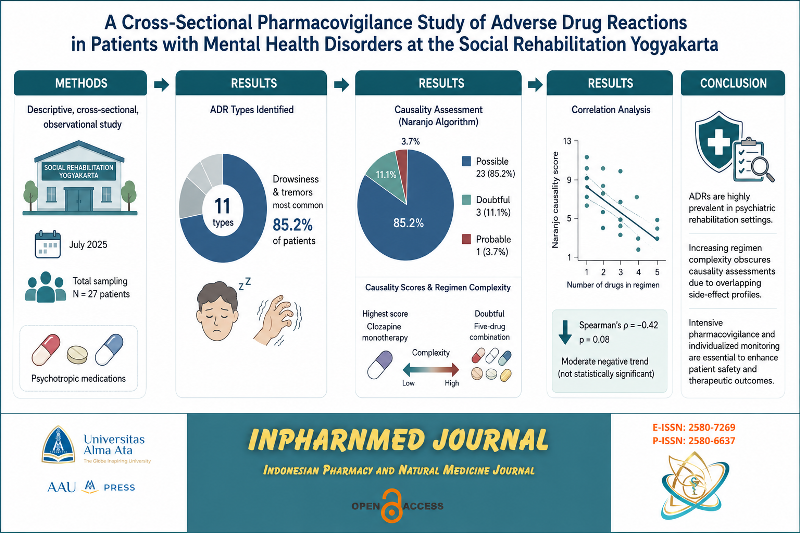
Background: Chronic mental health disorders require long-term psychopharmacotherapy, frequently necessitating complex psychotropic combination regimens that significantly elevate the risk of experiencing adverse drug reactions (ADRs).Objective: This study aimed to systematically identify specific ADR types, rigorously evaluate their clinical causality using the standardized Naranjo algorithm, and analyze the correlation between medication regimen complexity and the resulting causality scores.Methods: A descriptive, cross-sectional, observational study was conducted in July 2025 at the Social Rehabilitation Center Bina Karya and Laras (SRCBKL), Yogyakarta. A total sampling technique was successfully employed to recruit participants (N=27). Results: A total of 11 ADR types were identified, with drowsiness and tremors being the most prevalent clinical manifestations, affecting 85.2% of patients. Standardized causality analysis categorized 23 cases (85.2%) as possible, 3 (11.1%) as doubtful, and 1 (3.7%) as probable. Notably, the highest causality score was observed exclusively under clozapine monotherapy, whereas highly complex five-drug combination therapies were associated with doubtful classifications. Spearman’s rank correlation analysis revealed a moderate negative trend between the number of combined drugs within a regimen and Naranjo causality scores (), although this relationship was not statistically significant (). This negative correlation clinically highlights how overlapping side-effect profiles in combination therapies confound definitive drug-ADR attribution. Conclusion: ADRs are highly prevalent in psychiatric rehabilitation settings. While combination therapy remains a standard clinical necessity for complex cases, increasing regimen complexity significantly obscures causality assessments due to cumulative neuroreceptor blockades. These findings underscore the critical need for intensive pharmacovigilance and individualized medication monitoring to enhance patient safety and optimize therapeutic outcomes.
Authors

This work is licensed under a Creative Commons Attribution-NonCommercial 4.0 International License.