
Evaluation of Hospital Pharmacy Information System Using the PIECES Framework at Dr. Adhyatma General Hospital
Article Sidebar
-
Hospital Information Systems; Medication System; Personal Satisfaction; Pharmacy Service; Program Evaluation
Abstract
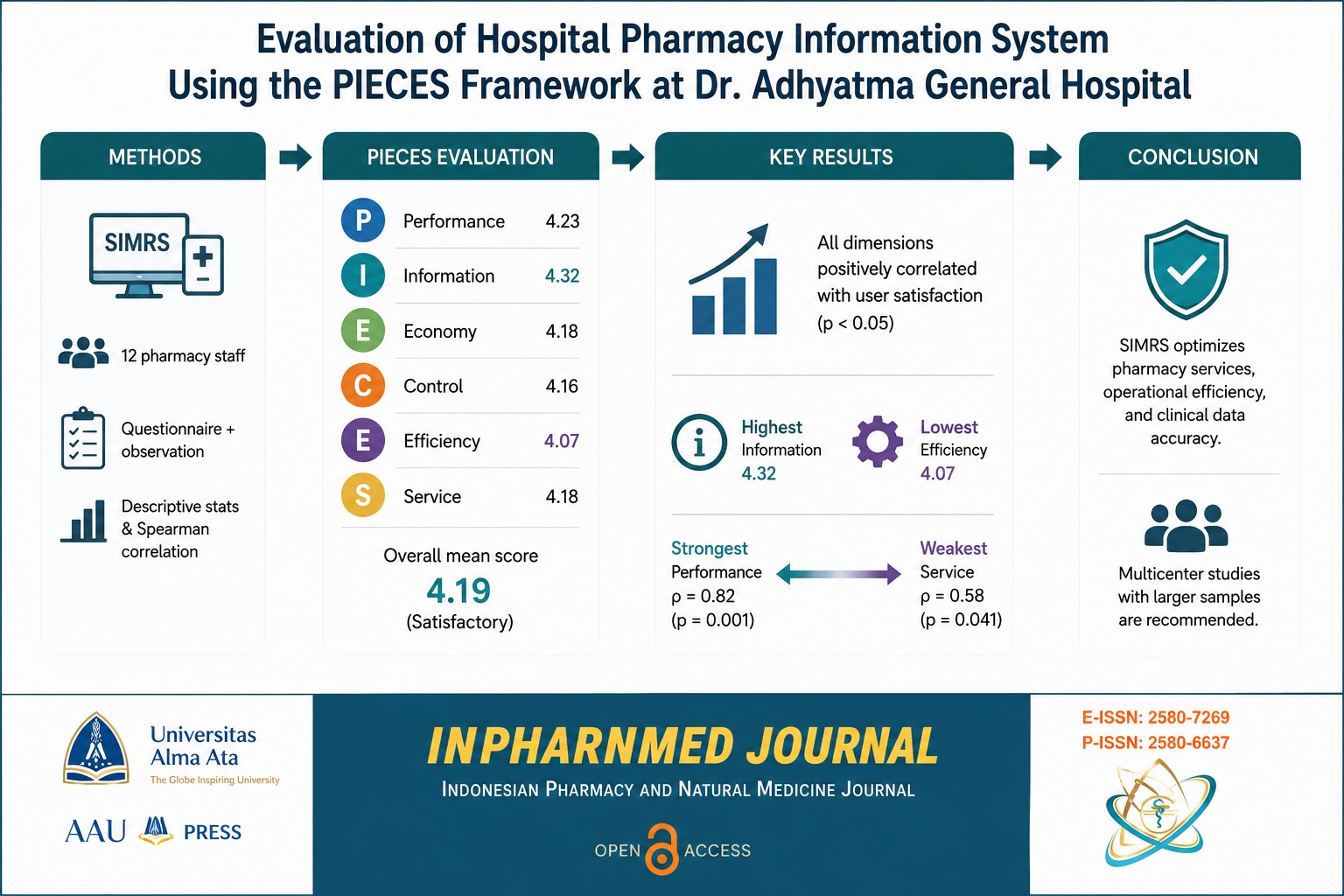
Background: Information systems played a crucial role in improving efficiency and service quality in hospital pharmacy management. Effective medication management was essential to prevent medication errors and ensure medication availability. However, comprehensive, multidimensional evaluations remained limited. The PIECES framework was selected for its comprehensive assessment of system Performance, Information, Economy, Control, Efficiency, and Service. Objective: This study evaluated the implementation of the Hospital Management Information System (SIMRS) at the Dr. Adhyatma General Hospital pharmacy using the PIECES framework and analyzed its correlation with user satisfaction. Methods: A non-experimental mixed-methods study was conducted using direct observations and expert-validated questionnaires. Using a total sampling method, 12 pharmacy staff members actively involved in medication management were included. Descriptive statistics were used to compute the PIECES dimension mean scores, and Spearman’s rank correlation was used to analyze their association with user satisfaction (p < 0.05). Results: The evaluated system demonstrated satisfactory capabilities across all PIECES dimensions, with an overall mean score of 4.19. The Information dimension scored highest (4.32), while Efficiency scored lowest (4.07), indicating a specific need to optimize workflow and usability. All dimensions were significantly and positively correlated with user satisfaction. Performance showed the strongest correlation (ρ = 0.82; p = 0.001), whereas Service showed the weakest, yet significant, association (ρ = 0.58; p = 0.041). Conclusion: The implementation of SIMRS effectively optimized pharmaceutical service management, operational efficiency, and clinical data accuracy. Due to limitations, including the small sample size and single-center design, the study recommended subsequent multicenter research with larger cohorts to validate these findings.
Authors

This work is licensed under a Creative Commons Attribution-NonCommercial 4.0 International License.